Entertainment and Creator Contracts: Ownership of Rights, Secondary Use, and AI Use

Hello, I'm Noriaki Asato, Representative Attorney at LegalAgent.
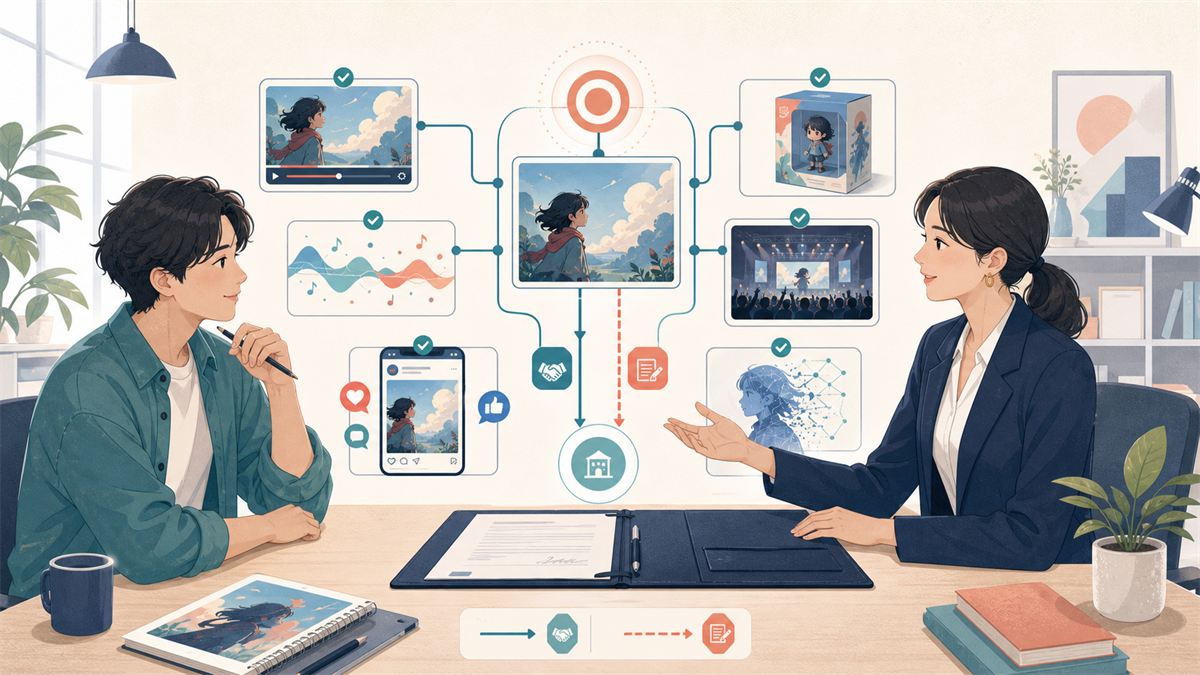
Businesses in the entertainment and creator space, such as video, music, and illustration, are expanding. In this space, the works and characters created are themselves the business value. You want to avoid the mistaken assumption that paying the production fee lets you use the work for any purpose. In the contract, decide who owns the copyright and secure the rights needed for the planned secondary uses and modifications. Discuss the terms of additional fees and revenue sharing at the same time. If you proceed with only a vague sense of "having them make it," "having them post it," or "having them appear," it may later become difficult to expand the business.
The Difference Between Assignment of Rights and a License
The first thing to confirm in a creator contract is whether the copyright in the deliverables will be assigned to you or whether you will receive a license to use it. With an assignment, the company acquires the copyright to the agreed extent. However, the rights under Articles 27 and 28 of the Copyright Act are presumed to be reserved to the assignor unless they are specifically mentioned in the assignment agreement. If you plan adaptations or the use of derivative works, check this point as well. With a license, by contrast, the rights remain with the creator, and the company can use the work only within the scope set out in the contract.
Which is better depends on the actual business. For example, for a one-off illustration for advertising, a license with the scope of use defined in the contract is often sufficient. On the other hand, for deliverables used for character IP, game assets, or long-term brand development, it may be necessary to secure broad usage rights or to choose to receive an assignment of the rights.
Describing Secondary Use Specifically
In entertainment businesses, arrangements for secondary use are indispensable. This is because there are many situations in which deliverables are used beyond their original purpose, such as in videos, on social media, and in advertising. Uses beyond the scope of a license may require an additional license. First check whether the use falls within the scope of the rights or licenses already obtained. When seeking an additional license, fees and revenue sharing also become matters for negotiation. Make clear the media, territory, and period of use, and state in the contract how far modifications are permitted and when additional fees arise.
Moral Rights of the Author and Modifications
Even if the copyright has been assigned to you, the author's moral rights cannot be assigned under the law. For this reason, when the company edits or processes deliverables, or regenerates them with AI, it may consider an agreement with the creator not to exercise moral rights (a non-exercise covenant).
However, it is not appropriate to understand that a non-exercise covenant allows you to freely make modifications that significantly impair the creator's name or the character of the work. Illustrators, musicians, writers, and others in particular take a strong interest in modifications to their works. Therefore, specifically setting out in the contract the range of modifications the company can make on its own and which modifications require prior consent tends to stabilize the relationship.
Making AI Use Explicit in the Contract
Recently, whether a creator's deliverables may be used as AI training data or for AI generation has become a practical issue. This is because cases in which multiple materials such as illustrations, voices, and text are input into AI to generate similar materials are increasing. Creators may be concerned about unintended reuse of their style or voice.
Whether the copyright holder's permission is required for AI training is determined in light of the requirements of Article 30-4 of the Copyright Act and other provisions. Even for non-enjoyment purposes such as information analysis, there are conditions, such as staying within the necessary limits and not unreasonably prejudicing the interests of the rights holder. Contractual restrictions, confidentiality obligations, and infringement arising from the use of generated output are checked separately. If the company anticipates use by AI, the contract should clearly state whether training use, generative use, and provision to third parties are permitted. Proceeding with AI use without prior explanation may significantly affect not only the contractual relationship but also the company's reputation.
The Client's Obligations Under the Freelance Act
In contracts with creators, alongside rights clearance, compliance with the Freelance Act (the Act on Ensuring Proper Transactions Involving Specified Entrusted Business Operators, in force since November 2024) cannot be overlooked. First, confirm whether the contractor falls within the scope of the Act, such as an individual who does not employ any workers. In covered outsourcing, the client, as a business operator, is obligated to clearly indicate the transaction terms immediately in writing or by electromagnetic means. In addition, where the client is a specified outsourcing business operator under the Act, the fee payment date must, as a rule, be set as early as possible within 60 days from the date the deliverable is received. Delaying acceptance inspection does not automatically push back the starting date for this payment deadline. For outsourcing of one month or longer by a prescribed client, the prohibition on unjustly low pricing and the like applies, and for continuous outsourcing of six months or longer, the requirement of 30 days' advance notice of mid-term termination or non-renewal and the like applies, subject to exceptions.
Putting the contract provisions in order is meaningless if practice, such as the operation of purchase orders and the management of payment dates, does not keep up. Reviewing the contents of the contract together with the day-to-day ordering flow reduces the burden of having to recheck rights and payment terms after you begin using the works.
Services Related to Creator Contracts
We provide support ranging from the design of rights ownership to AI use provisions and Freelance Act compliance through the following service:
Services connected to this topic