AI Use of Faces and Voices and Personality Rights: How Companies Should Design Permissions in Advertising Production
Hello, I'm Noriaki Asato, Representative Attorney at LegalAgent.
Narration that recreates a person's voice with AI, a digital human presenter created with generative AI, a commercial using synthetic speech modeled on a celebrity's way of talking. In advertising and content production, projects that use AI to recreate or synthesize the faces and voices of real people have become a realistic prospect. In such projects, the cases most likely to escalate into trouble are those where production or distribution goes ahead without the person's permission, or beyond the scope of the permission granted.
The Legal Grounds for Protecting Faces and Voices and Liability for Unauthorized Use
When using a person's face or voice with AI, analyze the economic value separately from the individual's personality interests. The final report (Japanese) published by a Ministry of Justice study group in August 2026 states that a voice is also information that identifies an individual and is subject to protection as a symbol of personality. This document sets out an interpretation of current laws and regulations and court decisions; it is neither the enactment of new legislation nor a judgment binding on the courts.
With respect to likeness, the right not to have one's name, likeness and the like used without good reason is recognized as deriving from personality rights. On that basis, the right to exclusively use the customer-attracting power of a celebrity's likeness and the like (the right of publicity) has been established as case law. The Supreme Court has set out a framework under which unauthorized use of a person's likeness and the like infringes the right of publicity and is unlawful as a tort where it can be said to be aimed exclusively at exploiting the customer-attracting power of the likeness, such as when the likeness itself is used as a product to be appreciated, when the likeness is attached to products in order to differentiate them, or when the likeness is used to advertise products (Supreme Court, First Petty Bench, judgment of February 2, 2012, the Pink Lady case). In that actual case, infringement was denied in light of circumstances such as the photographs having been used to supplement the content of a magazine article. Corporate advertising is among the examples given, but do not reach a conclusion based only on the advertising format; examine concretely whether the purpose can be said to be exclusively to exploit customer-attracting power.
Voices are likewise assessed from the perspectives of whether consumers can identify the voice as that of the person, whether it has customer-attracting power, and whether the use is aimed exclusively at exploiting that customer-attracting power. Because the evaluation comprehensively considers the similarity of the voice, accompanying text and images, and the manner of use, an impression that the voice is somewhat similar does not immediately lead to a finding of infringement. Separately from commercial value, the personality interest in not having one's voice used without good reason is also legally protected. The person's social status and activities, the purpose and necessity of the use, the public nature of the expression and other factors are weighed to determine whether the use exceeds the limits of what must be tolerated in social life. This issue extends to the voices of ordinary people as well, which can likewise be subject to protection.
Protection under the Unfair Competition Prevention Act should also be checked against the requirements of each provision. Causing confusion with a well-known indication (Article 2, paragraph 1, item 1) and misappropriating a famous indication (item 2 of the same paragraph) presuppose use as an indication of the source of goods or business; item 1 requires that confusion be caused, while item 2 does not require confusion as long as the indication is famous. Misleading representations as to quality, content and the like (item 20 of the same paragraph) cover representations that mislead as to the quality or content of goods, and damaging credibility (item 21 of the same paragraph) requires the communication or dissemination of false facts that harm the business credibility of another party in a competitive relationship. Using a celebrity's face or voice does not lead to the uniform conclusion that all of these categories apply.
Rights of likeness and publicity are not set out in a single direct statutory provision establishing a comprehensive right; they have been formed through the accumulation of case law. The absence of a dedicated law on voices is not a reason that voices may be used freely. Nor can legal liability be escaped merely because the advertising material was generated by AI. Taking into account that it was AI-generated, the identifiability of the person, the context of the presentation and the purpose of use are assessed individually. If the use is regarded as using the person's face or voice and meets the requirements for infringement of the respective rights, it will be difficult to escape liability merely on the formal difference that no data actually recorded or filmed of the person was used.
If production proceeds without prior permission, multiple legal and practical risks can materialize at the same time. The person or their talent agency may demand that use stop or that videos be deleted, and the company's advertising practices themselves may draw public criticism. Claims for damages based on infringement of the right of publicity or tort are also possible. For advertising that uses a celebrity's fame to drive purchases of a product, be careful of the risk that it will be regarded as aimed at exploiting customer-attracting power. Advertising media may also require submission of documents proving the permission arrangements, and the placement itself may be blocked.
Four Terms to Make Clear in the License Agreement
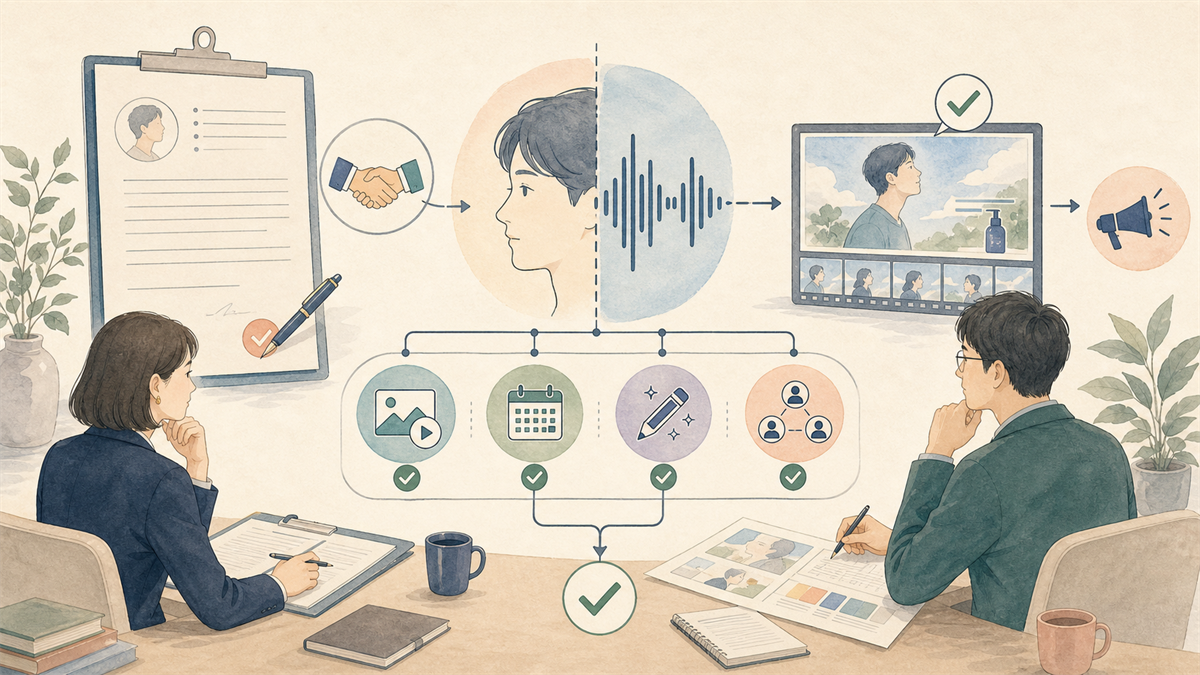
When obtaining permission from a person to use their face or voice, set out the contract terms specifically to prevent later differences in interpretation. The matters to agree on can be broadly organized into four. The first is the "scope of use." Specifically identify which distribution media it will run on, whether it is a video ad or an in-store display, and whether it is for advertising and promotion or internal use. If you stop at broad wording such as "to be used in advertising," disputes easily arise over whether it includes social media ads, outdoor screens and banner ads. The second is the "term of use." Make the start and end dates of use clear and decide whether to include an automatic renewal clause. Because AI-generated content can easily be copied and redistributed, also specify in the contract the retention and destruction of advertising data and model data after the contract term expires.
The third is the "scope of modification." Confirm how the original material and expression will be changed in the process of producing AI voice or AI video, and make clear how much processing is allowed. It is safer to agree separately on modifications that change what the person actually said, modifications that manipulate facial expressions or tone, and modifications that combine the person with other footage or characters, and to put in place a procedure for the person to review the final version in advance. In particular, training on a person's voice quality to create a proprietary voice model is fundamentally different in nature from playing back recorded data once. It is therefore important to state expressly in the contract whether modeling and additional training are permitted.
The fourth is the "rules for secondary use." Anticipate and set rules on provision to third parties other than the original contracting company, use within group companies, placement in overseas expansion, and whether the work may continue to be posted on the company's own website or archive as a portfolio piece after the contract ends. Entering into a contract that does not limit the scope of secondary use can cause the person's face or voice to take on a life of its own in situations beyond what the person anticipated. Note also that obtaining the person's permission is a separate process from clearing the copyright in the photos and scripts used and the neighboring rights held by performers and phonogram producers. Separately from the protection of voice quality itself, check whether the use of original sound recordings or photographs falls under a limitation of copyright or neighboring rights or requires permission, and if required, obtain it from the legitimate rights holder. When concluding a contract with the person, too, the basic step is to confirm that the agency or agent acting as the contact has legitimate authority to grant permission.
Advertising Representation Rules and Points to Check Before Starting Production
Even if the license agreement with the person is in place, checking the laws regulating advertising representations remains a separate matter. For example, an advertisement that makes it appear as if the person actually tried the product and is describing its effects will constitute a misleading representation if it meets the requirements of Article 5 of the Premiums and Representations Act, such as misleading ordinary consumers into believing that the quality or content of the product is significantly superior to what it actually is. Misleading representations as to quality, content and the like under item 20 of the Unfair Competition Prevention Act are also assessed individually based on the specific context of the representation. That said, under current Japanese law, there is no legal obligation under which an advertisement that does not state it is AI-generated is uniformly and immediately unlawful.
Whether a note or explanation such as "AI voice synthesis" or "generated based on the person's voice" is needed is determined in light of the overall impression consumers receive from the advertisement and the review standards each advertising medium sets independently. Note also that a small credit in the advertisement stating that it is AI-generated has no effect in excusing a lack of the person's permission or false representations about the product's effects.
When a company adopts AI voices or images of real people in advertising or promotional production, check the following items before the project gets moving:
- The nature of the model (whether it evokes a specific real person or is entirely fictional)
- Authority to grant permission and rights in the materials (confirming the contact with authority to grant permission on the person's behalf, clearing copyright and neighboring rights in the materials, and obtaining permission that sets out the scope, term, modification and secondary use)
- Consistency between the scope of permission and the placement plan (alignment of the media, distribution regions and placement period with the contract terms)
- Readiness of the representations under the media's review standards (confirming whether an AI-generated label is needed under the media's guidelines)
- Preventing reuse of previously licensed data (confirming that voice or video data licensed for a different past project is not being repurposed without permission)
Carry out this check at the project launch stage. If use beyond the scope of permission is discovered just before placement, options such as reshooting or replacing materials narrow, leading to schedule delays and additional costs. Copyright and training data issues relating to generative AI in general are covered in detail in Checkpoints on Generative AI, Copyright and Training Data. In addition, promotions using AI-generated content may involve both premium regulations and representation regulations, so please also refer to Key Points on Campaigns and the Premiums and Representations Act.
Legal Review Before Production
In advertising projects that use real people's faces or voices with AI, involving legal from the planning stage, before production gets fully underway, can reduce the risk of rework and rights infringement. LegalAgent provides advance legal review for advertising production through our IP and Entertainment Legal Services, which handle advertising projects involving the likenesses and voices of talent and celebrities, and our Advertising Review, which checks compliance with representation regulations and media standards.
Services connected to this topic