Steps for Collecting Accounts Receivable: From Reminders to Demand for Payment Procedures, Small Claims Actions and Lawsuits

Hello, I'm Noriaki Asato, Representative Attorney at LegalAgent.
Even after an invoice has been sent to a business partner, payment sometimes does not arrive, and the accounting staff report the delay. When the administration department inquires, the answer may be "our accounting processing is behind" or "we'll pay it all together next month," and the company may decide to wait and see for the time being. If the following month brings the same explanation and still no payment, you need to decide whether simply waiting is enough. To avoid delays in starting collection, it is important to decide in advance when such matters are reported internally and what the response policy is.
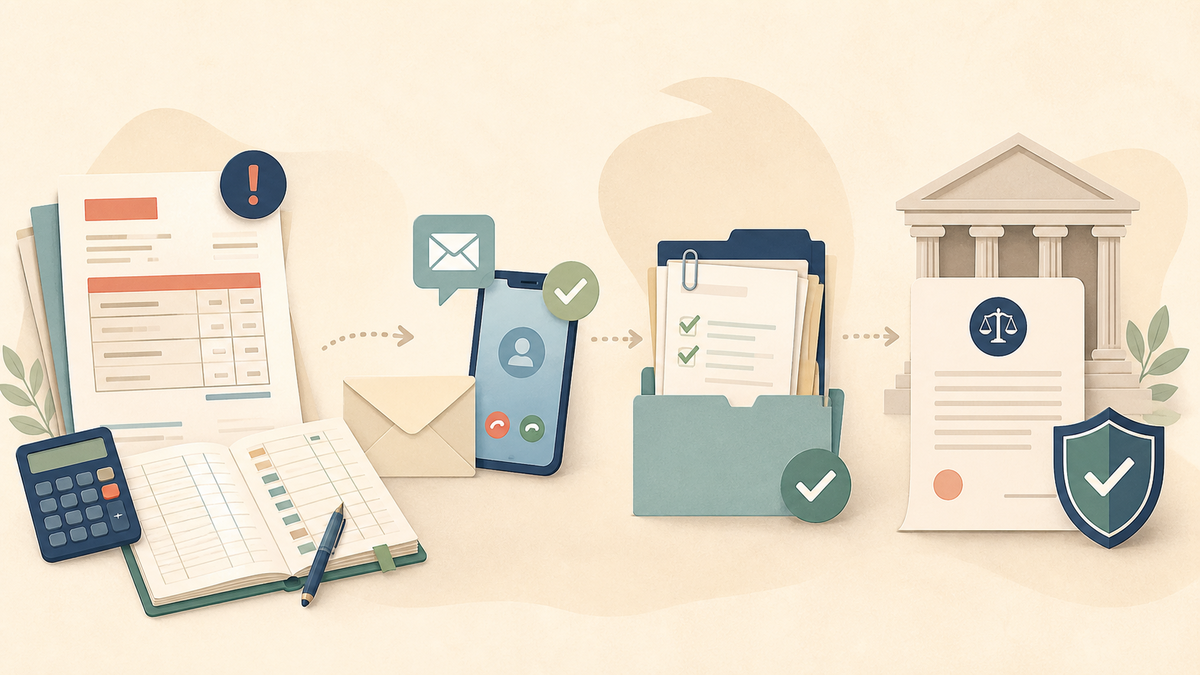
The means of collecting accounts receivable include reminders by phone or email, sending a letter by content-certified mail, demand for payment procedures (shiharai tokusoku), small claims actions and ordinary lawsuits. There is no legal obligation to proceed through them in this order, and where the completion of the statute of limitations is approaching or there is concern that the debtor's assets will be dissipated, the options include moving quickly to file a lawsuit or seek a provisional attachment. Which means to choose at which stage is decided by looking comprehensively at the size of the claim, the evidence at hand, the possibility that the counterparty will contest it, and the time remaining until the limitation period expires.
Initial Checks and Keeping Records of Contact When Payment Is Late
Before contacting the counterparty with a reminder, first check the company's own evidence. This means gathering transaction documents such as the contract, purchase order and delivery note, and confirming that they are consistent with the amount and payment due date stated on the invoice. At the same time, check whether the counterparty has explained the reason for the delay in past exchanges, and whether emails or meeting notes remain. If matters are handled only by word of mouth, you may end up with no evidence to show who said what and when if you later move to legal proceedings.
Also try to understand the counterparty's business condition. The speed of your subsequent response will differ depending on whether this is only a temporary delay in accounting processing or whether the counterparty's cash flow itself has deteriorated. Information about late payments to other business partners, a situation where the representative can no longer be reached by phone, and a sudden deterioration in performance in the most recent fiscal period are circumstances that suggest cash flow difficulties. This information alone does not establish insolvency, but considering the risk that assets will be dissipated while you keep sending reminders, consider your response early.
Immediately after noticing a late payment, the usual approach is to confirm the facts and send a reminder by phone or email. At this stage there is plenty of room to resolve the matter while preserving the business relationship, and you work out a specific payment date or a proposal for installment payments while hearing why payment is late. On the same day as a phone call, send an email such as "This is to confirm what we discussed on the phone today," keeping a record that includes any payment promise the counterparty agreed to orally. Recording what was agreed in writing or by email provides strong evidence in later proceedings.
If, after two or three reminders by phone or email, you cannot even obtain agreement on a specific payment date, that is a guideline for considering moving to written demands. This number is a rough guideline for convenience. Depending on the limitation period and the state of the debtor's assets, prepare court proceedings in parallel with the first contact.
Using Content-Certified Mail and Managing the Statute of Limitations
For a business partner that does not respond to informal reminders, consider sending a demand letter by content-certified mail. Content-certified mail is a system under which Japan Post certifies when, by whom, to whom and with what content a document was sent. The mail itself does not have the effect of certifying that the content of the document is true or establishing legal rights, but it allows the fact and date of the demand to be preserved as objective evidence. To prove the date on which the document reached the counterparty, use it together with delivery certification.
The demand letter should state concisely the amount claimed, the contract or invoice on which the claim is based, the payment due date, the payment method, and that legal proceedings will follow if payment is not made by the due date. State only objective facts based on the contract and delivery records, and avoid emotional language. If neither payment nor contact follows even after content-certified mail is sent, that is the stage to obtain advice from an attorney with a view to choosing legal proceedings. The initial response to contract disputes, including late payment, is also discussed in detail in What Is Contractual Non-Performance? The Difference from Breach of Obligation and the Initial Response in Corporate Legal Practice.
Managing the statute of limitations requires particular attention when collecting accounts receivable. Article 166 of the Civil Code provides that a claim is extinguished by prescription if not exercised within five years from the time the creditor becomes aware that it can be exercised, or within ten years from the time it becomes exercisable. To make the effect of prescription final, invocation by the counterparty is in principle required (Article 145 of the Civil Code), and for older claims to which the Civil Code as it stood before the amendments that took effect in April 2020 applies, the transitional measures of the time must be checked individually. For accounts receivable from ordinary commercial transactions, the creditor knows the claim becomes exercisable when it falls due, so in many cases prescription runs five years from the payment due date.
When a demand is made by content-certified mail, under Article 150 of the Civil Code the completion of prescription is postponed for six months from the time the demand reaches the counterparty. This is a temporary measure postponing completion for six months from the time of arrival; it does not add six months to the original expiry date. Sending repeated demands during the postponement period does not produce another postponement, so within those six months you need to take steps such as filing a lawsuit or a petition for a demand for payment (Article 147 of the Civil Code) or compulsory execution (Article 148 of the Civil Code), or obtain an acknowledgment of the debt from the counterparty (Article 152 of the Civil Code: renewal of prescription). A provisional attachment (Article 149 of the Civil Code) only has the effect of postponing completion for six months from the end of the event, and does not have the renewal effect of resetting the limitation period to zero.
When claiming late payment damages in addition to principal, check whether the contract provides for them. Article 419 of the Civil Code provides that damages for non-performance of a monetary obligation are in principle determined by the statutory interest rate at the first point when the debtor became liable for the delay, and that if the agreed interest rate exceeds the statutory rate, the agreed rate applies. The statutory interest rate under Article 404 of the Civil Code is reviewed every three years as one period, and in the current third period (from April 1, 2026 to March 31, 2029) it is 3% per annum. Even if the rate is revised after a delay arises, the rate for an obligation already in default does not change automatically. After confirming the validity of the contract terms, reflect them in the demand letter and court documents.
Choosing Among Demand for Payment Procedures, Small Claims Actions and Ordinary Lawsuits
If the matter is not resolved even after a written demand, or if a dispute is expected from the outset, use court proceedings.
A demand for payment procedure can be used to claim payment of money with no upper limit on the amount claimed. In principle, the petition is filed with the court clerk of the summary court with jurisdiction over the counterparty's address. Examination is conducted on the documents alone, and the order can be issued without appearing in court. However, it cannot be used where the counterparty's whereabouts are unknown and service by publication would be required. Once the original demand for payment is served on the counterparty, if the counterparty does not file an objection within two weeks of service, the petitioner files a petition for a declaration of provisional execution within 30 days from the time it becomes possible to do so. Before a declaration of provisional execution is issued, the counterparty can object even after the initial two weeks have passed. Once the demand for payment with a declaration of provisional execution is served on the counterparty, compulsory execution can be sought. To actually collect, you identify the target assets and file a separate petition. The counterparty can also object within two weeks of service of the demand for payment with a declaration of provisional execution. If the counterparty files a lawful objection, the matter moves to ordinary litigation, which entails a corresponding burden such as appearing on hearing dates.
A small claims action is a special procedure available at the summary court only for claims for payment of money of JPY 600,000 or less. In principle, the examination is completed in a single hearing and judgment is rendered on the same day, so it suits cases where evidence that can be presented immediately, such as the contract and delivery notes, is in hand. The counterparty can request a transfer to ordinary litigation, for example before presenting arguments on the merits at the first hearing, and the court may also transfer the case to ordinary litigation. A party dissatisfied with the judgment may file an objection with the same summary court within two weeks of service of the judgment or the record, a procedure that differs from an ordinary appeal. There is a statutory limit on the number of times it can be used at the same summary court within the same year. If you seek full recovery of an amount exceeding JPY 600,000, choose a demand for payment procedure or an ordinary lawsuit.
If the counterparty disputes the formation of the contract or the amount claimed itself, if the claim exceeds the limit for small claims actions, or if an objection is filed against a demand for payment, the matter is resolved through an ordinary lawsuit. A suit is filed with the summary court or the district court, and the examination proceeds with both sides presenting arguments and evidence. Depending on the issues in the case, there may be several hearings, but many hearings are not always required. Even after a judgment is obtained, work remains until payment is actually received. If the counterparty does not pay voluntarily, you need to investigate the counterparty's assets and petition for compulsory execution.
The fees paid to the court when filing are set according to the amount in controversy, based on the quick-reference fee table as of September 2026. The fee for a demand for payment is JPY 7,700 for a paper filing and JPY 7,500 for an electronic filing for an amount in controversy of JPY 1 million, and JPY 12,700 for a paper filing and JPY 12,500 for an electronic filing for JPY 3 million. The fee for an ordinary lawsuit (filing a civil action, with one defendant) is JPY 12,500 for a paper filing and JPY 11,400 for an electronic filing for an amount in controversy of JPY 1 million, JPY 22,500 for a paper filing and JPY 21,400 for an electronic filing for JPY 3 million, and JPY 32,500 for a paper filing and JPY 31,400 for an electronic filing for JPY 5 million. Additional amounts may apply where there are multiple defendants, and attorney fees and the costs of compulsory execution after winning should also be budgeted for separately.
Internal Tasks to Start Toward Collection
If late payment has continued for a long time, I recommend promptly proceeding with the following internal tasks toward collection:
- Collecting and cross-checking the contract, purchase orders, invoices, delivery notes and past communication records for each business partner
- Preparing a list of payment due dates and limitation expiry dates for each business partner, and identifying claims approaching the limitation deadline
- Recording, by email or other means, the content of reminders previously given only orally
- Drafting a demand letter to be sent by content-certified mail
- Considering whether a demand for payment procedure, small claims action or ordinary lawsuit is appropriate, based on the evidence at hand and the unpaid amount
If there is no prospect of payment despite repeated reminders, or if there are suspicious signs in the counterparty's financial condition, it is time not to keep the matter within the company but to consult an attorney and settle on a course of action that includes legal measures.
Consultations on Unpaid Receivables
In collecting accounts receivable, preserving evidence properly from the early stages, managing the limitation period and taking steps suited to the case keep a wide range of legal options available. Because decisions on managing the statute of limitations, drafting demand letters and choosing court proceedings suited to the case depend on the contract documents and evidence at hand, consulting early is helpful.
At LegalAgent, in addition to individual engagements in Debt Collection and Insolvency, we continuously support day-to-day legal work, including drafting demand letters and managing limitation periods, through legal outsourcing.
Services connected to this topic