Examples and Templates for Generative AI: Contract Review Formats and Precautions

Hello, I'm Noriaki Asato, Representative Attorney at LegalAgent.
When you ask generative AI to summarize a contract review, the order of the items and the length of the explanations may change each time. Providing one example of the result you want can make it easier to communicate your preferred style and format. An example does not, however, guarantee that the response will be accurate.
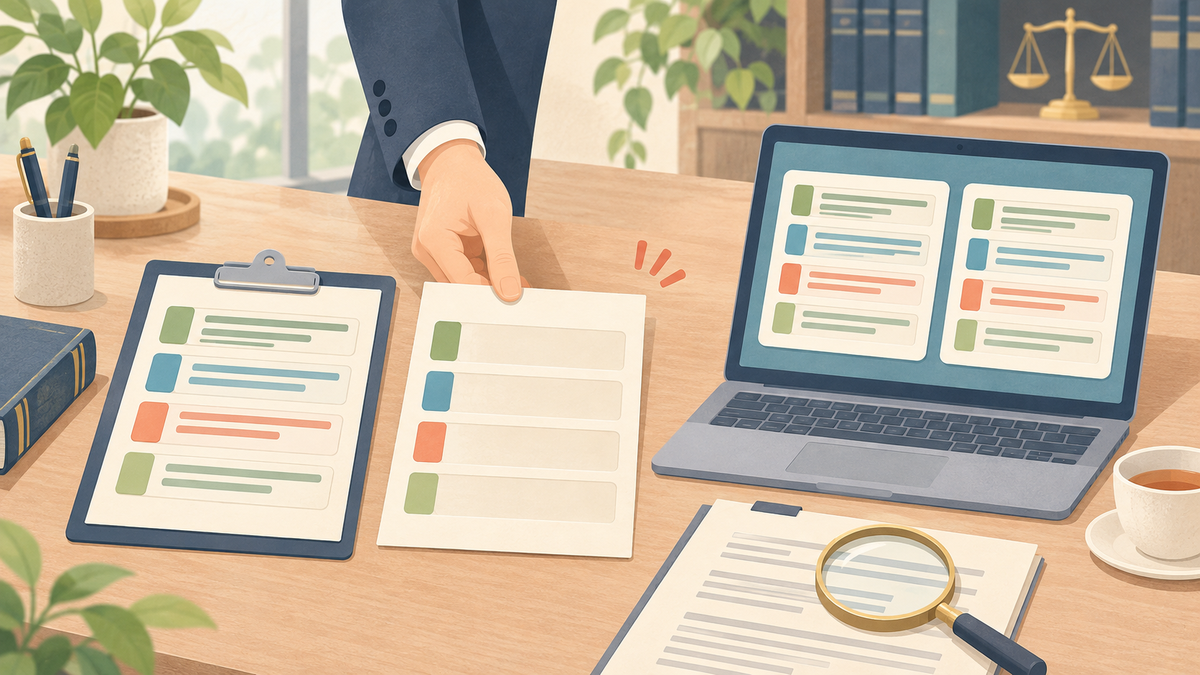
For example, consider a situation in which you want a contract review summarized in your company's usual format. Try attaching a sample review memo to an instruction such as "Organize the clause names, risks and proposed revisions." This shows the desired order of the items and how much detail to provide about each risk.
Giving a new team member a completed sample is also one way to explain an assignment. When requesting work from generative AI, combining instructions with an example can show what the deliverable should look like. Before entering the example, check how confidential information and personal information in it will be handled.
What an example can communicate
Instructions such as "Use polite language" or "Organize this into bullet points" can be interpreted differently by different recipients. Generative AI can likewise produce something that differs from your intentions when given only abstract descriptions.
Providing a sample in the desired format makes it easier to request a response that follows its structure and tone. Anthropic's official guide also discusses examples as a way to communicate format and style. It describes starting with one example, checking the response and adding examples if needed.
A previous email requesting revisions that led to agreement can also serve as a sample when drafting a new request to a counterparty. Asking the AI to "Match this tone" gives it a concrete indication of the style you want.
Types of examples for legal work
Legal teams often have internal materials that can serve as examples. Common options that are easy to incorporate into everyday work include the following.
- Style examples: a previous email requesting revisions, with an instruction to use the same degree of politeness
- Format examples: a blank table or outline listing the contract type, parties, principal obligations and termination conditions
- Review-item examples: the company's nondisclosure agreement checklist, with an instruction to review the agreement against those items
- Detail-level examples: an internal review memo illustrating how deeply to examine risks and how to phrase conclusions
One particularly useful approach is to provide the company's review items or contract templates. For a services agreement, these might cover permission to subcontract, ownership of intellectual property, acceptance criteria and the scope of damages. Explaining the company's standards for each item makes it easier to request a review against those standards.
Example prompts
The basic approach is to provide a blank form first and ask the AI to organize the contract's contents using it.
Please organize the contract's contents using the following form.
Keep the field names unchanged and fill in the blanks.

[Form]
- Contract type:
- Parties and roles (which side our company is on):
- Contract term and whether renewal is provided for:
- Our company's principal obligations:
- Conditions for termination and early termination:
- Provisions concerning damages:
- Points requiring particular attention (start with three, with reasons):

For each item, include the supporting clause number.
If the contract does not address an item, write "Not stated" rather than guessing.
Identify any information needed to make an assessment that is missing.
If there are other significant points, add them rather than limiting the list to three.

[Paste the contract here]
Specifying the form first makes it easier to compare several contracts using the same items. Even where counterparties arrange their clauses differently, you can ask for matters such as the scope of confidential information or termination conditions to be placed in the same fields. The reviewer should check that the clause numbers in the response correspond to the original text.
A more advanced approach is to provide a completed example and ask the AI to use the same style, instead of supplying a blank form. This can be useful when you want consistency in both the depth of the discussion and the tone.
I will show you one example of our company's risk memos.
Using the same structure, style and level of detail,
prepare a risk memo for the different contract pasted after the example.
Do not carry over the facts or conclusions in the example to the contract being reviewed.
For each finding, include the clause number in that contract and any information missing from the assessment.

[Example]
- Contract type: software development services agreement (our company is the customer)
- Principal risk: unclear acceptance criteria could result in acceptance being deemed to have occurred even if the work is incomplete
- Proposed response: request explicit acceptance criteria and an obligation to remedy defects if the work fails acceptance
- Priority: high

[Contract to be reviewed starts here]
(Paste the different contract here)
A completed sample can communicate the order of the items, sentence length and phrasing. The example above is an illustrative example of a format. It does not mean that the contract being reviewed has the same acceptance-related risk, so check separately that each finding corresponds to the original text.
Choosing an example for the purpose
The right material depends on what you want the example to accomplish. Deciding what you want to make consistent before choosing a sample helps avoid rework.
Previous correspondence and notices can help when the aim is to adjust the tone. For example, a message telling a counterparty that a contract will not be renewed may fail to communicate the intention accurately if it is too forceful or too tentative. One approach is to provide a previous message that worked smoothly and ask the AI to "Use this degree of politeness."
Providing a checklist as an example is useful when you want to reduce omissions. When reviewing SaaS terms from the user's perspective, review items may include service suspension conditions, data handling and deletion, limitations of liability and the procedure for changing the terms. Supplying the company's own items allows you to request a response against the same items each time. Do not treat issues outside the checklist as having been reviewed.
A blank form is useful when you want to compare several contracts side by side. For nondisclosure agreements with different counterparties, recording the terms in the same format makes differences in the definition of confidential information and the duration easier to compare.
Precautions and preventing mistakes
There are several points to consider when using examples.
- Checking the material: a preliminary review for actual counterparty names, personal names and specific transaction amounts in the previous document
- Final human review: a process in which the responsible person assesses legal validity directly, even when the output looks polished
- Selecting the current version: use of the latest form or template currently used internally, rather than an outdated format
- Checking internal rules: confirmation of whether internal checklists and templates may be entered into external tools
When an example looks polished, its contents can appear correct as well. A well-organized format and a correct legal assessment are different things, so the responsible person should compare the contents with the original text. Even with personal and company names removed, the details of a transaction may identify the counterparty. Check what may be entered for both the example and the contract being reviewed, taking account of the service's contractual terms and the company's internal rules.
Support for developing examples across the organization
Our pages on legal playbook development and support for generative AI use in legal departments describe assistance with organizing internal review items and templates into materials that are easy to use in everyday work.
Services connected to this topic