Follow-Up Questions for Generative AI: Refining Contract Reviews

Hello, I'm Noriaki Asato, Representative Attorney at LegalAgent.
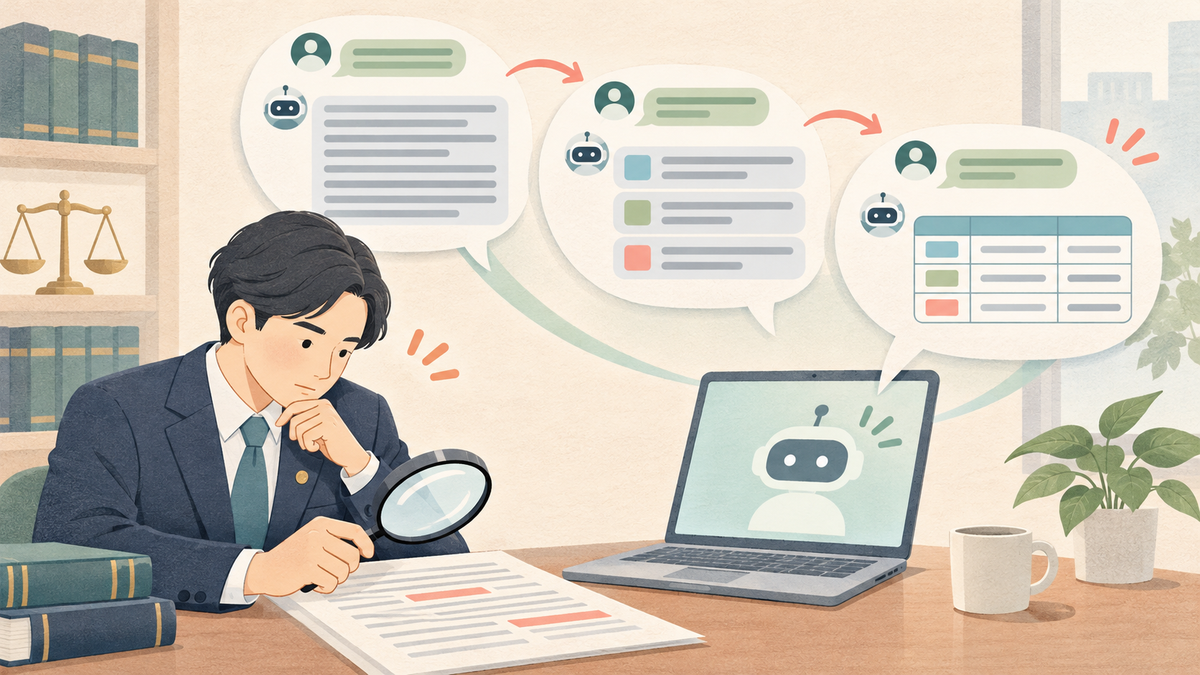
When people first start using generative AI, they often try too hard to obtain a perfect answer that meets every requirement in a single instruction. When requesting a review of a services agreement, for example, they may try to pack their contractual position, priority clauses, output format and writing style into one prompt. The resulting complexity can produce an answer that misses their intent. Instructions to generative AI can be revised after reading the response. I find it useful to identify what is missing from the initial answer and address those gaps with additional questions.
The Roles of the Initial Answer and Further Instructions
Treat the first response as a working draft whose substance needs to be checked by the person responsible. Add any missing perspectives, then shorten lengthy explanations to suit their intended use.
When assigning work to a colleague, an initial memo is rarely ready to send outside the organization without revision. Feedback such as "Make the summary a little shorter" or "Explore the risks from the service provider's perspective in greater depth" helps improve it. Similarly, additional requests, or follow-up questions, can bring an AI response closer to something useful in practice.
OpenAI's official guide also describes revising instructions after reviewing a response and adding background information. Further dialogue does not guarantee that errors will disappear, so the substance still requires a separate check.
Common Types of Follow-Up Requests
Several types of additional instructions are useful in practice. To reduce length, ask for a summary that is half as long. To explore an issue more closely, request an explanation of the damages clause with concrete examples. Other useful instructions include switching from the customer's perspective to the service provider's and identifying disadvantages, or reorganizing the identified concerns into a three-column table showing the clause, risk and proposed response.
Further adjustments can make the material more useful for the company's circumstances. For example, ask for technical terms to be rewritten in plain language before sharing the response with operational teams, or narrow the discussion to the three most important points.
Checking the Basis of an Answer and Addressing False Information
If an AI-generated observation is unclear, follow up by asking why that conclusion follows or what supports it. If the response says that a termination provision disadvantages the company, ask which wording causes which disadvantage. This can turn a vague concern into a specific issue for negotiation.
The explanation supplied by AI may itself be wrong. Plausible explanations can contain hallucinations, including nonexistent statutory provisions or invented cases. Do not take a cited basis at face value: check the original sources, such as the legislation or a case-law database.
Examples of Step-by-Step Refinement
Start by identifying the company's position and the material to be reviewed, then use further dialogue to narrow the issues and intended use of the text. The following examples assume that the material may be entered into an environment approved for that use.
(Initial request) Our company is the service provider. Identify five
points of concern for the provider in the following services agreement.

(Follow-up) Thank you.
Which of these are particularly important when our company is the
service provider? Narrow the list to three and explain why.

(Further request) Rewrite those three points for an explanation
to our internal business team, avoiding technical terms.
A further application in contract review is to explore the issues by changing the position or perspective in stages.
(Initial request) Identify points of concern in the following SaaS
terms of use from the customer's perspective.

(Follow-up) Take the points you have identified concerning service
interruptions, data handling and data deletion after termination.
Reorganize them into a table with three columns:
clause / risk to the customer / amendment to seek in negotiations.

(Further request) Which items in that table do you think the other
party, the service provider, would find difficult to accept?
Explain your reasons.

(Final request) Rephrase them as courteous requests intended
to be sent to the other party.
Separating the choice of perspective, change of format, prediction of the other party's reaction and refinement of wording makes it easier to check which changes have been reflected. The other party's reaction remains an AI-generated prediction. Compare it with the contractual terms and the actual course of negotiations.
Pitfalls in Continuing a Conversation
A common difficulty is requesting changes to length, format, perspective and terminology all at once. Too many changes can lead to incomplete compliance, so it is sensible to limit each follow-up to one or two changes. Switching from the customer's perspective to the service provider's during a conversation can also cause earlier context to become mixed with the new assumptions. If the underlying premises change substantially, starting a new conversation is generally more reliable.
For continued safe use in practice, pay attention to the following matters.
- Confirmation of the approved environment and permissible inputs, with necessary masking of confidential and personal information
- Direct comparison of material matters, including amounts, deadlines and exclusions of liability, against the original contract
- Restatement of the conditions in a new conversation if a lengthy exchange has made the premises unclear
- Substantive review and the final decision by the responsible person before any external submission
Supporting Adoption in Legal Work
Making small adjustments to instructions through dialogue can become part of an organizational workflow, allowing colleagues to share ways of giving instructions and checking responses. LegalAgent supports both more efficient contract review and the development of operating rules.
Services connected to this topic