What Is Generative AI? A Gentle Introduction for Legal Staff
Hello, I'm Noriaki Asato, Representative Attorney at LegalAgent.
Recently, I have been receiving more consultations from people who say, "We'd like to try using generative AI in legal work too." At the same time, I sense that quite a few legal staff members have not touched it at all, saying, "I don't really understand what generative AI is in the first place, and I feel vaguely uneasy about it."
For example, a manager says, "Please look into whether the legal team could use ChatGPT," but the staff member cannot sort out what it can do and what is risky, and so cannot take the first step. Or business units have started checking contracts with generative AI, and the legal team suddenly needs to get up to speed on the basics. We receive consultations like these as well.
Here, keeping technical jargon to a minimum, I explain what kind of tool generative AI is, where in legal work it is useful, and the premises you should know before you start using it, together with sample prompts you can copy and try. You do not need to become a technology expert. The aim is to give you a picture of how to use it safely in your daily work.
The Basic Mechanism and Characteristics of Generative AI
Generative AI is AI that generates text, images, audio and so on based on patterns it has learned. Here I focus on generative AI that handles text, which is the most relevant to day-to-day legal work. Well-known examples include chat-based conversational services such as ChatGPT, Claude and Gemini.
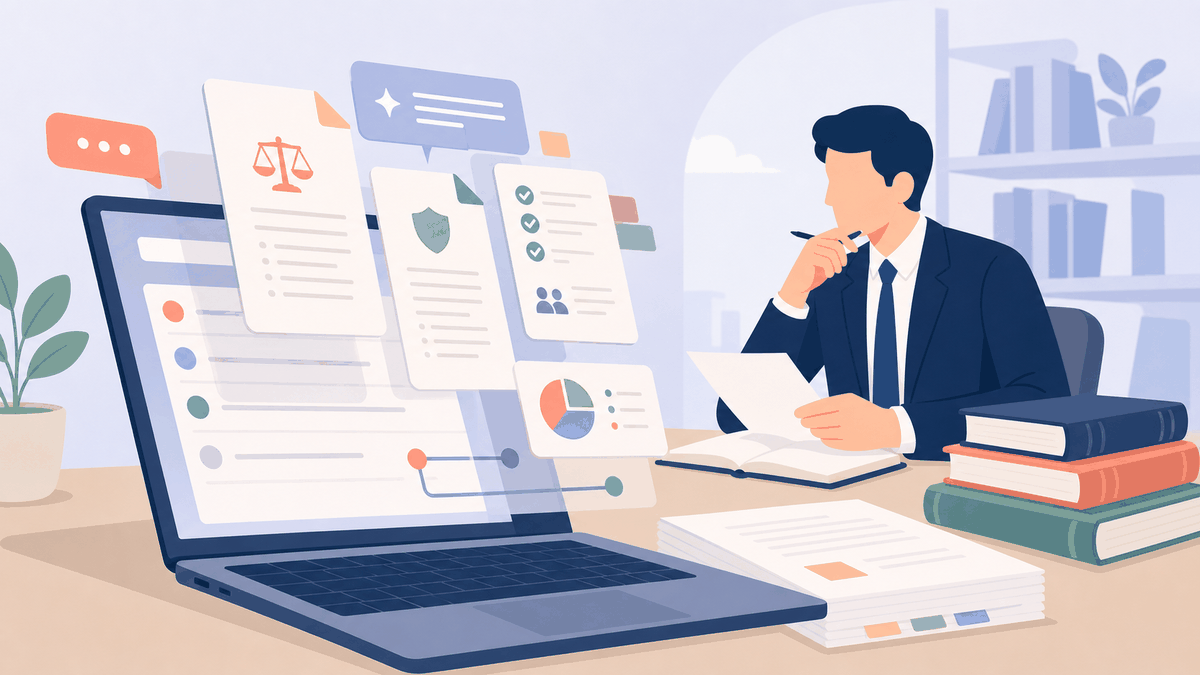
As a picture of how it is used, it may help to imagine "an assistant with extensive knowledge who reads, writes, summarizes and rephrases text quickly" standing by on the other side of the screen. It is like having a new hire who has read many legal treatises ready to help you with drafts at any time.
When you type a question into the input field on the screen, an answer comes back in text, as if you were having a conversation with a person. If you enter a contract clause and instruct, "Explain what this clause means so that someone in a business unit without legal knowledge can understand it," it returns a plain explanation; if you ask, "Summarize this confidentiality agreement in five lines," it returns a summary. The text of these instructions to the AI is called a "prompt". In practice, it is enough to think of it as "specific written instructions to the AI".
Let me also touch briefly on how generative AI puts together its answers. The language models used for text generation string sentences together while probabilistically choosing "the word most likely to come next", using the input context as a clue. Because they have learned from an enormous amount of text data, their word choice in context is highly accurate, and the result is natural text that reads as if a person had written it.
What you should keep in mind is that generative AI is not a mechanism that "searches for the correct answer and brings it back". It composes text on the spot based on the knowledge it has learned and the context entered. Recently, more services combine search functions or reference to external materials, but even when sources are attached, the premise that a person checks the output does not change.
This mechanism brings both advantages and cautions to legal practice. On the positive side, it is very good at "drafting", "rephrasing" and "summarizing", tasks for which there is no single correct answer. On the side requiring caution, there is a risk that it will confidently output content that differs from the facts while presenting it in a plausible form. It may present non-existent article numbers or fictitious court decisions as if they were real. This phenomenon is called "hallucination", and I will cover it in detail on another occasion.
Where It Excels in Legal Practice
Day-to-day legal work centers on reading and making sense of large amounts of text, such as contracts, board minutes and past review materials. Generative AI is good at exactly this process of "reading, organizing and writing text". For that reason, I think it is especially effective at the stage of initial groundwork in contract review. In practice, use in tasks such as the following is realistic.
- Listing and organizing key clauses in an NDA (non-disclosure agreement), such as the definition of confidential information, the prohibition on use for other purposes and the survival period
- Identifying clauses that the client side should watch in a service agreement (scope of deliverables, acceptance inspection, subcontracting, damages, termination, etc.)
- Summarizing a long email from a business partner and listing in bullet points the issues to consider in the reply
- Drafting explanations, broken down for business units, of difficult contract clauses full of technical terms
- Preparing a first draft of a concise internal risk assessment memo
Each of these tasks takes considerable time if a person writes it from scratch, but with a rough draft in hand, it can be finished quickly through rounds of checking and revision. I think generative AI is a tool that greatly advances this groundwork.
Its Limits as a Tool and the Human Role
While it is a good fit in these ways, generative AI is not a tool that can do everything. Understanding at the outset "what cannot be left to AI" allows you to bring it into your work safely.
First, AI does not on its own know the internal circumstances specific to your company. Internal background information, such as how far you compromised with a particular business partner in past negotiations or what level of risk tolerance your company has, will not necessarily be reflected appropriately unless it is entered or can be obtained from materials you have permitted it to reference.
Second, the final legal judgment cannot be left to AI. Judging a question such as "Should we accept the cap on damages?" involves a management decision that comprehensively weighs the importance and size of the transaction, the scale of damage in the event of an information leak, and so on. Generative AI can help identify the issues, but it is the human role to reach a conclusion with responsibility.
Third, it may not accurately reflect the latest amendments to laws or recent official guidelines. Because it may not have information from after the point at which it was trained, or may have only a fragmentary understanding, an attitude of always checking primary sources is indispensable where up-to-date statutes and systems are required.
Therefore, I think it is best to start by having generative AI produce drafts or first versions, which you then verify yourself. Have the AI create a first draft, have a person check its content, and finish it by adapting it to your company's context. With this approach, you can raise your work speed while keeping quality control and responsibility for the work in your own hands. In contract review, a suitable division of roles is "have the AI draw guidelines that prevent issues from being overlooked, and have a person decide the final risk judgment and how strongly to press requests to the counterparty".
Specifying Prompts to Try in Practice
At first, using public information or general contract templates that contain no confidential information, trying out the tool with instructions like the following will give you a feel for it. Please enter text in a form that does not include personal information or the individual terms of transactions.
Act as an assistant with extensive experience in corporate legal work. Summarize the text I am about to paste in five lines for legal staff. Add a brief explanation in parentheses for any technical terms. Finally, if there are points that should be checked further, list three of them.

[Paste the text you want summarized here (non-confidential only)]
The instructions set the role as "a corporate legal assistant", but this is a device to steer the tone and perspective of the answer; it does not mean the AI legally guarantees attorney qualifications or professional expertise. The premise is that the user always reads through and checks the output.
Once you are used to the basic form, specifying your company's position and the contract type concretely makes it easier to obtain answers that are practical to work with. Rather than asking broadly, "Tell me all the problems," narrowing down the angles you want checked makes it easier to get answers aligned with the issues you want to confirm.
Act as an assistant with extensive experience in corporate legal work. Review the following contract from the position of the service provider (the party receiving the work). For each of the following perspectives, organize the points to watch.

1. Scope of deliverables and acceptance conditions
2. Whether subcontracting is permitted
3. Scope and cap of damages
4. Conditions for termination
5. Ownership of intellectual property rights

Divide the output for each perspective into three parts: "Summary of the clause", "Concerns" and "Points to confirm". Note that this answer is a draft, and the final decision will be made by a person.

[Paste the contract text here (non-confidential only)]
Stating clearly whether you are the client or the service provider, or the disclosing or receiving party of information, makes it easier to obtain answers that fit your company's position. This is in common with the practical approach in day-to-day contract review of "first understanding your company's position".
Checking Habits to Avoid Pitfalls, and Where to Consult
To make safe use of generative AI in day-to-day work, let me summarize the common pitfalls and the points to check in advance.
First, do not swallow the AI's answer whole as the correct answer. Because generative AI produces natural and persuasive text, even content containing errors can look correct at first glance. It is important to make a habit of always checking article numbers, names of laws, court decisions, specific figures and proper nouns against primary sources.
Next, do not hand questions over wholesale. If you simply ask, "Is there any problem with this contract?", you may get a general explanation that is hard to use for that matter. Giving specifics such as the contract type, your company's position and the issues you want to focus on increases the usefulness of the answer.
And do not casually enter your company's confidential information or personal information. A habit of pausing before pasting text to check whether it includes business partner names, specific contract amounts, unpublished transaction terms, names of people in charge and the like will protect you. Simply masking names is not enough; it is important to confirm, through the terms of use and internal standards, whether the service you use uses input data for training and what its policy is on retaining communication logs. If your company has rules on the use of generative AI, always follow them regarding the services approved for use and the scope of information handling.
We provide support tailored to individual circumstances on how to use generative AI in a way that suits your company and on reviewing your contract review structure. We handle everything from the initial stage of "not knowing where to start" to supporting the use of generative AI in the legal department. For details of our support, please see the following.
Frequently asked questions
What is generative AI?
It is a general term for AI that newly generates text, images, code and other content based on patterns learned from large amounts of data. In the legal field, it has begun to be used for summarizing contracts, drafting proposed revisions, organizing issues, knowledge search and similar tasks.
What is the most important point to watch when using generative AI in legal work?
The plausible output of non-existent statutory provisions or court decisions (hallucination), and the handling of confidential information. The premise is that research results are always checked against the original sources and that the scope of information that may be entered is set as an internal rule.
Is it a problem to paste a contract into a free chat AI?
Depending on the service and settings, input content may be used for training, which can be a problem in relation to confidentiality obligations. You need to check whether data is used for training, where it is stored and who has access rights, and choose a plan and settings suited to business use.
Services connected to this topic