Why LegalAgent was founded as a law firm for the generative-AI era


Hello, this is Legal Agent.
LegalAgent is a generative-AI startup working to change corporate legal practice through the combination of AI and practicing attorneys. We do not stop at building and distributing software tools as SaaS. Instead, our attorneys use internally developed AI agents to deliver completed legal work, such as contract review and drafting, directly to clients through an AI-BPO or BPaaS model.
Concretely, the service is built around: a published fee example of ¥10,000 per NDA review (excluding tax), responses generally within one business day, and legal outsourcing with scope, pricing, and delivery schedules confirmed for the matter.
Legal Agent, a law firm for the generative-AI era
Here I want to talk plainly about why I founded a law firm run as an AI-BPO, how generative AI gets used inside it, and what our own product looks like. The founding grew out of real discomfort with a structural problem in the legal industry.
Structural challenges in corporate legal practice
The legal industry has operated under traditional working methods for many years. I began my career at Anderson Mori & Tomotsune handling M&A matters, and later practiced at AZX Partners, focusing on startup legal needs. Both firms provided valuable experience, and I learned a great deal from colleagues at each firm.
Even so, both environments reflected a common structural pattern: junior associates and staff handle large volumes of documents while a senior attorney reviews and corrects the work. On large M&A due diligence projects, for example, teams of ten to fifteen attorneys would work through the night reviewing materials over multiple days. During my time as an associate, colleagues and I often wondered how long that working style could remain practical.
In my work, I saw how the cost and pace of this structure could frustrate clients.
A large team billing by the hour could generate substantial fees. A review that took a week could delay a transaction, and advice that identified a risk without explaining the available responses could leave a client unsure how to proceed. These were concerns behind my decision to build the firm, rather than a description of every firm or matter.
Corporate clients generally seek legal counsel that moves at commercial speed, at reasonable cost, and with practical guidance that helps projects move forward rather than merely cataloging potential liabilities. Yet the multi-layered associate review model, prolonged routing through multiple reviewers, and an overly cautious stance repeatedly stood in the way. I spent years looking for a practical way to address that dilemma.
Generative AI as a catalyst for new service design
The arrival of GPT-4o marked a turning point in my personal assessment of the technology. Compared with earlier models like GPT-3.5, it handled complex text with surprising fluency. In my own testing at the time, its speed in processing legal materials matched or exceeded what junior personnel could produce on a first pass.
That experience suggested that traditional staffing pyramids built on large headcounts might no longer be essential. A compact team of attorneys using AI effectively could produce comprehensive legal deliverables while significantly cutting turnaround time and redesigning the cost structure of legal work. I saw an opportunity to build the kind of service I wanted to offer.
That realization led directly to the founding of Legal Agent. Rather than operating strictly as a software provider, we structured the business as a practicing law firm to deliver completed legal solutions, learning through practical trial and error along the way.
Service delivery through a law firm rather than standalone software
Contract review tools sold as SaaS have gained widespread adoption. They provide genuine utility, and their growth represents a positive digital transformation for the legal sector. However, a SaaS model encounters an inherent last-mile boundary: the customer still needs someone to verify the proposed work and take responsibility for using it. Some tools can also apply revisions directly; that feature does not remove the need for review.
While AI highlights potential contract risks, deciding how to resolve those risks, how to negotiate provisions with counterparties, and whether a given clause aligns with internal corporate policy remains human work. A busy in-house legal team often does not need another standalone application; it needs qualified support to take the work across the finish line.
There is also a strategic distinction between distributing software and delivering legal services. Selling software licenses and billing for completed legal work represent distinct business operations. I chose to focus on the completed legal work itself: a service model where clients engage attorneys who use internally developed AI systems to produce finished legal work, while also offering that software independently.
Instead of treating AI output as a finished deliverable, we use AI to generate thorough preliminary drafts that our attorneys examine, refine, and verify to commercial standards. This structure defines our Business Process as a Service (BPaaS) approach. While SaaS provides the software application alone, BPaaS delivers the underlying legal process and completed deliverables built upon it.
We now make our proprietary Word add-in available as software to external legal departments and law firms as well. Nonetheless, our primary business remains the professional service delivered by attorneys experienced in using that platform.
Client communication integrates directly into existing routines: a team sends a message via Slack or Teams noting the context, such as requesting a contract review with a balanced tone because the counterparty is an established enterprise. Behind the scenes, attorneys work alongside the AI agent, returning revised Word documents with standard tracked changes. Clients do not need new account credentials or prompt syntax; they submit requests in their existing chat platforms and receive customary legal deliverables.
Workflow development and the human-in-the-loop model
Deploying AI in actual operations required significant trial and error. Initially, we assumed that passing assignments entirely to AI would yield complete answers automatically, but that assumption quickly proved flawed.
In an early effort to automate review pipelines, I built close to 200 workflows using the no-code platform Dify. These setups relied on detailed branching logic, such as checking whether specific clauses were present before routing to subsequent steps. Over time, maintaining nearly 200 distinct workflows became impractical. When statutory rules evolve, judicial interpretations shift, or individual transactions require bespoke exceptions, updating dozens of interconnected flowcharts creates severe friction. Legal practice constantly presents unique circumstances, making rigid pre-programmed rule trees unsuitable for complex contracts.
We therefore shifted direction from full automation toward a human-in-the-loop workflow, where an attorney collaborates interactively with AI. Software engineers familiar with modern AI code editors understand the advantage of conversing with an assistant that directly suggests code diffs. We adapted that concept to Microsoft Word, developing an internal add-in that functions like an associate drafting alongside the attorney inside the document. The interface places an AI chat panel directly beside the active Word text.
An attorney instructs the assistant much like delegating to an associate, asking it to adjust specific definitions or contract clauses. The AI examines the document context, applies targeted revisions as tracked changes, and inserts or replies to margin comments. The attorney then reviews and confirms the proposed revisions. In our day-to-day practice, this interactive process substantially reduced initial drafting time, allowing experienced attorneys to focus their attention on verification, risk allocation, and client-specific judgment.
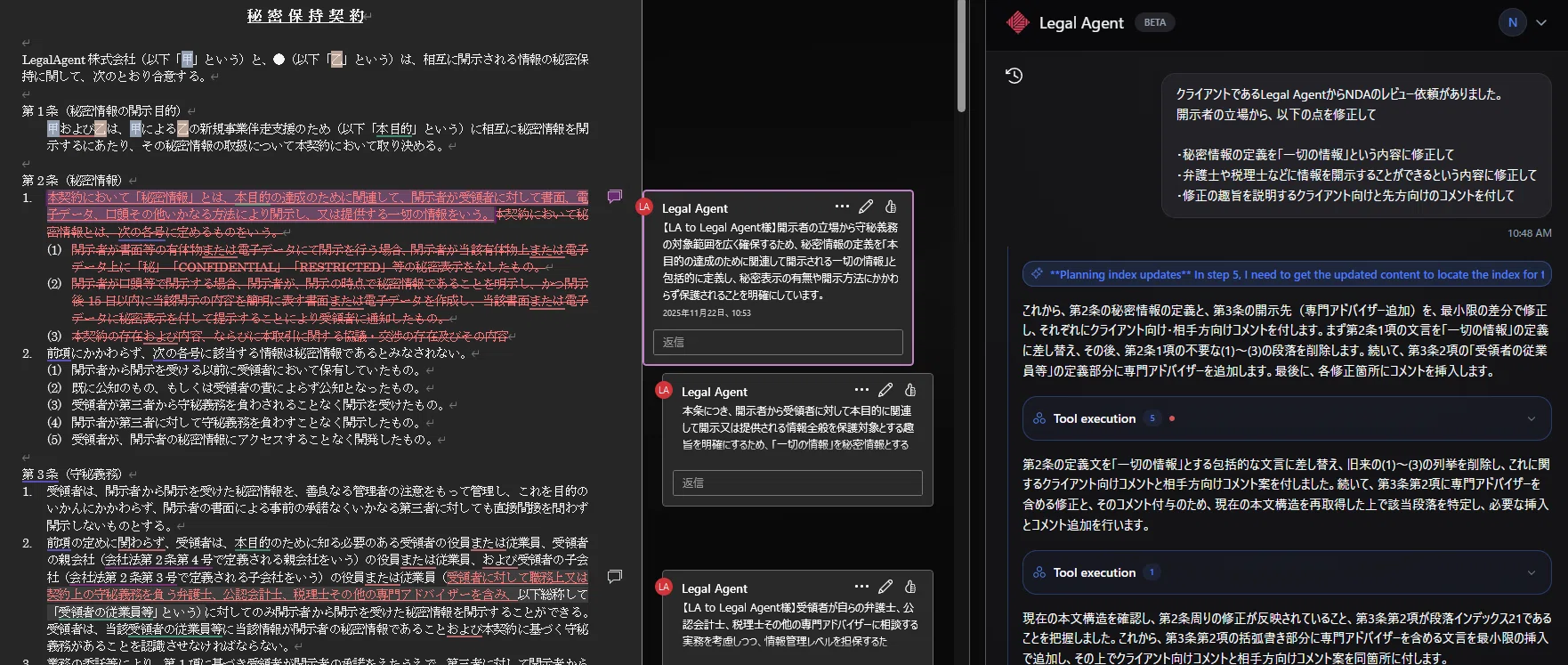
The Word add-in screen
This workflow also alters the traditional firm hierarchy. The conventional staffing pyramid relied on numerous junior associates conducting research and preparing initial drafts, followed by multiple rounds of partner review. Under an inverted model, AI assists with initial drafting and comparative analysis, while experienced attorneys review the output, identify gaps, and provide seasoned legal judgment. This structure does not remove the need for careful legal verification; rather, it shifts senior attention directly to evaluating substantive recommendations.
This approach offers distinct operational advantages for boutique firms and specialized practitioners. For some projects, this combination may allow a smaller team to take on more work, provided it has the capacity and expertise to check the results. Our long-term goal is to build a collaborative federation of specialized attorneys supported by this shared operational foundation.
I expect similar approaches to develop in accounting and consulting as well. Sustainable efficiency comes from skilled professionals working alongside AI to produce refined deliverables. Legal Agent continues to develop this model, and those interested in participating can review our current open positions across legal, engineering, and business roles.