Preparing the Data Room for Legal Due Diligence: Version Control and Organizing Documents So AI Can Read Them

Hello, I'm Noriaki Asato, Representative Attorney at LegalAgent.
In startup fundraising, M&A and IPO preparation, investors and buyers may conduct legal due diligence (legal DD). In legal DD, a wide range of materials has traditionally been reviewed, including registrations, articles of incorporation, contracts and labor-related documents, but with advances in AI technology, the way it is carried out is changing. This is because using AI makes it possible to quickly search across contracts, extract information through OCR and cross-check against minutes.
The results extracted by AI feed into the work of checking them against the source materials to confirm their legal meaning. The scope of the investigation is also decided for each matter; this does not mean that every fundraising round carries a uniform legal DD obligation. In legal DD in the AI era, how the data room is prepared determines the quality of verification. The effort and accuracy of verification change greatly depending on whether the documents are placed in a form that AI can read, whether version control is maintained and whether unnecessary personal information is mixed in.
The Data Room as a Working Environment and Management of Originals
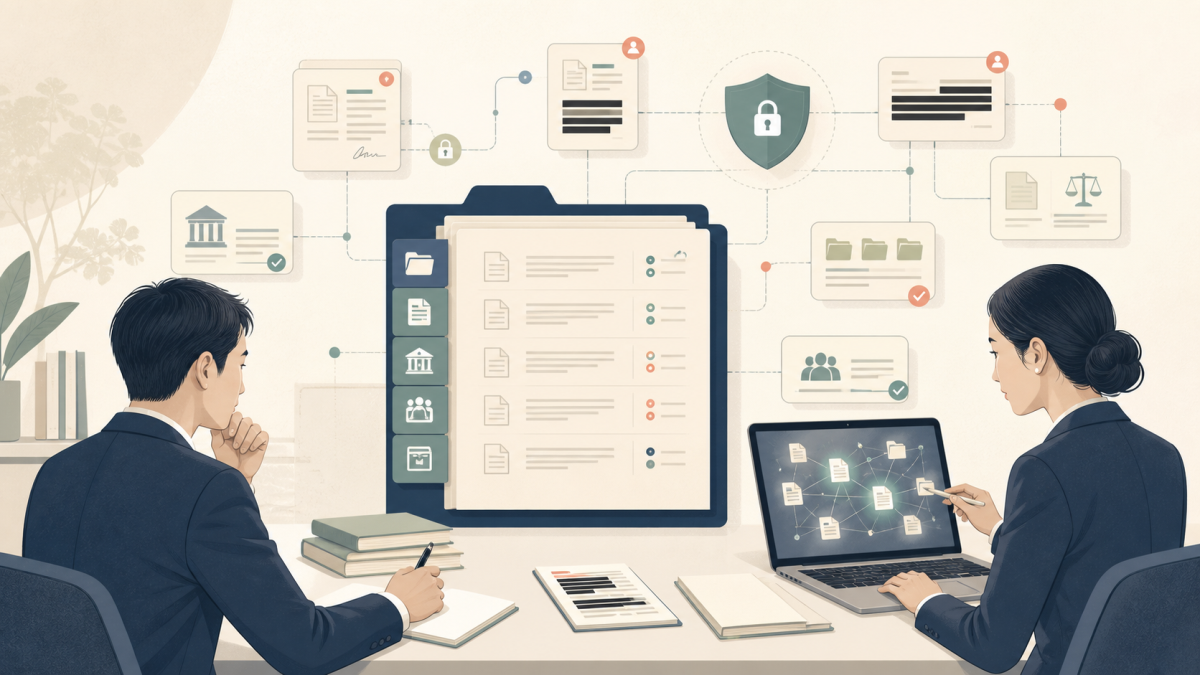
The data room for legal DD is a working environment in which investors, buyers and attorneys verify the target company's legal risks. Arrange the documents so that they are easy to find and the position of each is clear. If the same contract is duplicated, executed versions and drafts are mixed together, or file names remain as "scan001," a great deal of time will be spent just finding the documents.
Using AI tools does not solve this problem. AI helps with searching and extraction, but whether all files have been reviewed is separately confirmed using the document list and processing records. AI may miss attached tables, handwritten corrections and missing documents, so it is indispensable for people to check the location and content of the original sources with their own eyes. In addition, text copies made for AI analysis must be clearly distinguished from the originals, overwriting originals and erasing Word tracked changes must be avoided, and scans of signed originals must be retained.
Organizing Files With AI Analysis in Mind and Preparing a Management Spreadsheet
To manage documents in a way that is easy for both AI and people to understand, state the contract type, the counterparty and the execution date in the file name. This is so that the type of contract can be identified without opening the file. At the same time, place related documents, such as the executed main contract, amendment memorandums and individual purchase orders, in the same folder or at a nearby level.
Further, create a contract management spreadsheet listing the contract name and the counterparty. Also list the contract term, the deadlines for termination and renewal, and the payment terms. If you provide columns for checking whether there are limitations of liability or non-compete obligations, and also record where provisions on IP ownership, subcontracting and anti-social forces are located, it becomes easier to cross-check against the text of the contracts. However, the management spreadsheet is merely a summary of the primary materials and is no substitute for the signed contracts. Making both the management spreadsheet and the originals available for review allows responses to questions to proceed smoothly as well.
Designing Disclosure in Light of the APPI and Tools' Terms of Use
In legal DD, designing how far to disclose personal and confidential information is important. Labor materials, customer contracts and minutes of board of directors' meetings may contain names, compensation, health information and customer information. Consider disclosure restrictions such as masking for officers' compensation and raw employee data, but note that redaction does not immediately make the information anonymously processed information under the Act on the Protection of Personal Information (APPI). For highly confidential materials such as source code, also consider setting up a clean room that limits who can view them.
When processing data room materials with external AI, you need to sort out the rules under the APPI on supervision of outsourcees (Article 25), provision to third parties (Article 27) and provision to third parties in foreign countries (Article 28). Even if an NDA has been signed with the buyer, that does not automatically authorize transmission to external AI providers or use for model training. Provision in connection with business succession (Article 27, Paragraph 5, Item 2) is also an exception that applies when legitimate requirements are met, such as a protective agreement at the negotiation stage, and does not necessarily exempt the company from obtaining individuals' consent unconditionally. Check the terms of the AI tool and confirm the scope and period of the logs retained and whether the data is used for training. Do not judge solely by what the settings display; also check the contract terms and the scope of use actually permitted.
Items to Check in AI-Related Materials and Preparing an Issues Memo
At companies that use AI themselves, AI-related materials are also subject to legal DD. The AI Guidelines for Business issued by the Ministry of Economy, Trade and Industry and the Ministry of Internal Affairs and Communications are guidelines that encourage voluntary efforts by businesses, and Version 1.2 was published on March 31, 2026. They can be referred to as a guide when examining each company's efforts. For companies providing AI products, the sources of training data and the scope of the licenses are questioned. Check the terms of use of external APIs and the contracts with model providers, and make sure the company can explain for what purposes customer data is used. Organize matters so that the storage location of prompts and outputs, whether they are diverted to training and the deletion procedures can be presented as documentation.
It is also effective for the company to prepare a memo on the main issues in advance. Summarize the history of changes in shareholders and of the preferred shares and stock options. Also cover issues relating to important contracts, labor and licenses, and describe the matters identified in disputes and anti-social forces checks and the status of the response. Because a buyer using AI can quickly search across the entire data room, if the company discloses only documents without organizing the issues, it may receive a flood of unexpected questions all at once and be kept busy responding. Attaching an issues memo in advance makes it easier to focus the review.
Support for Legal DD and Data Room Preparation
LegalAgent supports legal DD responses, data room preparation and the creation of contract management spreadsheets in preparation for startup fundraising, M&A and IPOs. In my view, in legal DD in the AI era, well-organized document management on a day-to-day basis forms the foundation, together with review by professionals. Details of our support for preparing for legal DD and organizing data rooms can be found on the pages below.
Services connected to this topic